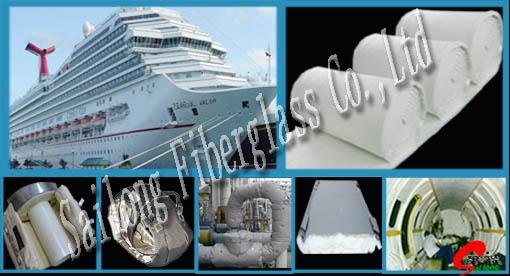
Heat insulating material for ship
1、Excellent Heat Suppression: Heat conductivity Coefficient between 0.02-0.040w/cm.k, According to physical principle, better heat suppression materials provide lower rate of thermal conductivity also contain higher density of air holes. We produce the fiberglass insulation mats contain numerous tiny air holes, and distribute irregularly.
2、 Nonflammable,
Raw material consist slicide (more that 50%), incombustible, no deformation, less resistant to breakage, heat resistant up to 7000C
3、It has excellent sound-absorbency effect to vibration nosie which can absorb almost 90% ofnoise pollution.
4、 High Insulation – it is excellent for heat preservation and insulation characteristics
5、 High corrosion resistance
Fiberglass resists strong acid and alkali, and will remain stability for long period of time.
6、Excellent Tensile Strength: it can prevent heavy smash up to approx 1.0kg or above.
7、 Low moisture absorption: rate close to zero.
8、 Light weight and soft; comparison to other fire-proofing materials, fiberglass needle mat is lighter, softer, therefore it is very suitable to machines systems.
9、Size can be varied and customized.
Application:
1、For the insulation of any high temperature equipments and central air condition pipe.
2、For seal, sound absorption, filtering and insulation for certain area.
3、For heat transfer, thermal energy storage equipments.
4、Aviation and space flight: thermal and acoustic insulation for thin panel and nail-board by fire-proofing fabrics, used for the thermal insulation and sound absorption of engine system, Absorbing noises and purifies the tail gas.
5、For noises absorption of the engine/exhaust pipe in car, motor vehicle.
6、Heat insulation for industry equipment, parts and duct and household electrical appliances
Fibreglass Mat Property
|
Thermal and Optical Properties
|
Fiberglass is inorganic fiber and will not combustion
|
|
Thermal Expansion Coefficient:4.8*10-6cm/cm/℃
|
|
Specific heat:0.19cal/g℃
|
|
Thermal conductivity Coefficient: 0.040w/cm.k
|
|
Heat Resistant Temp: 700℃
|
|
Conversion Rate(25℃):1.55
|
|
Mechanical Properties
|
Fiberglass has high tensile strength and good stability in length
|
|
Tensile Strength:350kg/mm2
|
|
Elastic Modulus:7300kg/mm2
|
|
Horizontal Tensile Strength:35.6N/50mm
|
|
Vertical Tensile Strength:97.2N/50mm
|
|
Conductance
|
Fibreglass have good electric insulation
|
|
Permittivity:102Hz104Hz-6.32, 1010Hz-6.11
|
|
Loss Tangent: 102Hz-0.0042, 102Hz-0.006
|
|
Volume Resistivity:1010Ωcm,
|
|
Corrosion
|
Fibreglass will not absorb water, will not contribute to metal corrosion and will not decay
|
|
Fiberglass Chemical Composition(Weight%)
|
|
SiO2
|
Al2O3
|
CaO
|
MgO
|
B2O3
|
Impurity
|
|
R2O
|
Fe2O3
|
Other
|
|
54.1±0.5
|
14.6±0.4
|
16.6±0.3
|
4.6±0.3
|
8.8±0.5
|
<0.8
|
<0.5
|
Allowance
|
Fiberglass Thermal Conductivity:
|
Temperature(℃)
|
25°
|
100°
|
200°
|
300°
|
400°
|
500°
|
600°
|
700°
|
|
Thermal Conductivity
(kcal/mhr℃)
|
0.030
|
0.037
|
0.048
|
0.058
|
0.076
|
0.094
|
0.112
|
0.16
|
Fibreglass Absorption and Vibration Property:
Product Specification:
|
Thickness
|
Density(kg/M3)
|
Weight(kg/ roll)
|
Length(M)
|
|
3MM
|
130
|
12-20
|
40
|
|
4MM
|
130
|
16-27
|
40
|
|
5MM
|
130
|
18-24
|
30
|
|
6MM
|
140
|
22-31
|
30
|
|
8MM
|
140
|
20-30
|
20
|
|
10MM
|
140
|
24-36
|
20
|
|
12MM
|
150
|
32-43
|
20
|
|
15MM
|
160
|
30-40
|
15
|
|
20MM
|
180
|
32-40
|
10
|
|
25MM
|
180
|
40-50
|
10
|
- The size can produce as per customer’s request
- Density Tolerance: +15%, -10%
|